


For a pharmaceutical manufacturer, the question “Should we move to the cloud?” is rarely as straightforward as it sounds.
Your IT team may want scalability. Finance may want lower infrastructure costs. Operations may demand predictable performance. Security teams may want tighter control. Quality and compliance teams may ask a more fundamental question: Can we modernize without compromising data integrity, auditability, availability, or regulatory obligations?
This is why private cloud vs on-premises infrastructure is not simply a technology debate.
It is a business-risk decision.
I have seen organizations remain on aging on-premises infrastructure because they fear that cloud adoption will introduce compliance or operational uncertainty. I have also seen organizations rush toward cloud adoption without first understanding workload dependencies, validation requirements, or the operational consequences.
Both approaches can create problems.
The right answer is not to choose cloud because it is modern or on-premises because it feels familiar. The right answer is to determine which architecture best supports the workloads, compliance requirements, operating model, and growth strategy of the business.
A recent Croyant Technologies engagement with a leading pharmaceutical manufacturer provides a practical example of how that decision can be approached.
Learn more about the hidden cost of poor IT infrastructure on SMBs
Private Cloud vs On-Premises Infrastructure: What Is the Difference?
At a fundamental level, on-premises infrastructure means the organization owns and operates the computing, storage, networking, and associated systems within its own facilities or controlled data center environment.
A private cloud provides cloud-like capabilities such as resource pooling, virtualization, automation, scalability, and centralized management within an environment dedicated to a single organization.
The distinction matters because private cloud can provide greater infrastructure flexibility without requiring a pharmaceutical organization to surrender the level of control it may require for critical workloads.
But neither model automatically solves infrastructure problems.
A poorly designed private cloud can become an expensive virtualized data center.
A poorly maintained on-premises environment can become a serious operational and compliance liability.
Architecture matters more than labels.
Why Pharmaceutical Manufacturers Have a Different Infrastructure Challenge
Pharmaceutical manufacturing operates under constraints that many other industries do not face to the same degree.
IT infrastructure supports systems involved in manufacturing, quality, supply chain, finance, inventory, documentation, and other business-critical processes. At the same time, organizations must maintain strong controls around data integrity, security, traceability, availability, and regulatory requirements.
That makes infrastructure decisions more complex.
The challenge becomes even greater when an organization has accumulated technology over many years.
Applications may run on separate servers. SAP may operate independently from line-of-business applications. Integrations may rely on older interfaces. Infrastructure teams may maintain multiple environments simply because replacing them introduces risk.
This is exactly the type of complexity Croyant encountered in its pharmaceutical manufacturing engagement.
The client was running SAP ECC alongside multiple line-of-business applications across isolated servers. The fragmented environment created data silos, increased complexity and maintenance costs, and made future scalability more difficult. Regulatory requirements added another layer of pressure.
Learn more about how to modernize SAP ECC infrastructure.
That is the real starting point for modernization.
Not “cloud versus data center.”
Fragmented infrastructure versus an architecture designed around business needs.
When On-Premises Infrastructure Still Makes Sense
Despite the momentum behind cloud adoption, on-premises infrastructure should not be dismissed.
There are legitimate reasons for retaining workloads on-premises.
1. Specific control requirements
Some organizations need direct control over infrastructure configuration, physical access, network architecture, or data location.
2. Stable, predictable workloads
If workloads have consistent capacity requirements and the organization already operates an efficient data center, replacing the environment may not immediately produce financial benefits.
3. Legacy application dependencies
Some older applications were never designed for cloud environments. Moving them without addressing dependencies can introduce performance, integration, or validation challenges.
4. Specialized infrastructure
Certain manufacturing environments may depend on specialized equipment, low-latency connectivity, or tightly integrated operational technology.
The mistake is assuming that keeping these workloads on-premises means keeping the entire IT estate unchanged.
That is where modernization needs to begin.
When Private Cloud Becomes the Better Option
Private cloud becomes particularly attractive when organizations need the control of dedicated infrastructure combined with the flexibility of cloud operating principles.
For pharmaceutical manufacturers, potential advantages include:
- Greater resource flexibility
- Improved infrastructure utilization
- Centralized management
- Faster provisioning
- Easier scalability
- Better workload consolidation
- Reduced dependence on individual physical servers
- A stronger foundation for hybrid cloud adoption
However, these benefits only materialize when the architecture is properly designed.
A private cloud should not simply reproduce the same fragmented environment using virtual machines.
It should simplify the environment.
The Croyant Case: Why the Client Chose Private Cloud
Croyant Technologies faced this exact challenge while modernizing the infrastructure of a leading pharmaceutical manufacturer.
The organization needed to improve performance and reliability while addressing fragmented infrastructure, rising maintenance overhead, regulatory requirements, and future scalability.
Rather than treating the problem as a straightforward server replacement, Croyant designed a broader infrastructure modernization strategy.
The client’s SAP ECC environment was transitioned to a private cloud using an HPE HANA Appliance and SUSE Linux, with the objective of improving performance and reliability while reducing dependence on the existing on-premises server environment.
This was an important architectural decision.
The goal was not simply to “move SAP to the cloud.”
The goal was to create a more manageable infrastructure foundation around a business-critical workload.
That distinction is crucial for organizations considering private cloud vs on-premises infrastructure.
Compliance Should Influence the Architecture From Day One
For pharmaceutical manufacturers, compliance cannot be added after infrastructure deployment.
It needs to influence the architecture.
The infrastructure must support appropriate controls around:
- Data integrity
- Availability
- Access management
- Auditability
- Monitoring
- Backup and recovery
- Change management
- Disaster recovery
In the Croyant engagement, the architecture incorporated HPE Serviceguard Cluster and SUSE Clustering to strengthen high availability and disaster recovery while supporting data integrity and regulatory requirements.
This is where infrastructure modernization becomes strategically valuable.
You are not simply replacing servers.
You are building an environment where resilience and compliance become architectural capabilities.
Cloud adoption does not remove regulatory obligations. The organization remains responsible for ensuring its regulated systems and processes meet applicable requirements, while cloud infrastructure can provide controls and capabilities that support those obligations.
AWS, for example, describes continuous monitoring and logging capabilities for GxP environments, illustrating how infrastructure controls can support traceability and compliance.
The Biggest Mistake: Treating Cloud Migration as the Finish Line
A pharmaceutical organization can migrate workloads to a private cloud and still have a fragmented IT environment.
That is why the next question should always be:
What happens after the migration?
Can new applications be integrated efficiently?
Can infrastructure scale without another major hardware investment?
Can legacy applications coexist with modern workloads?
Can teams manage the environment consistently?
Can the architecture support future digital initiatives?
The Croyant project addressed these questions by establishing a VMware Cloud Foundation-based hybrid cloud model. This provided a foundation for integrating legacy applications with modern cloud services while supporting scalability for future line-of-business applications and digital initiatives.
That is a more mature approach to modernization.
You are not choosing between yesterday’s infrastructure and tomorrow’s cloud.
You are creating an architecture capable of supporting both.
Private Cloud vs On-Premises Infrastructure: What Should You Evaluate?
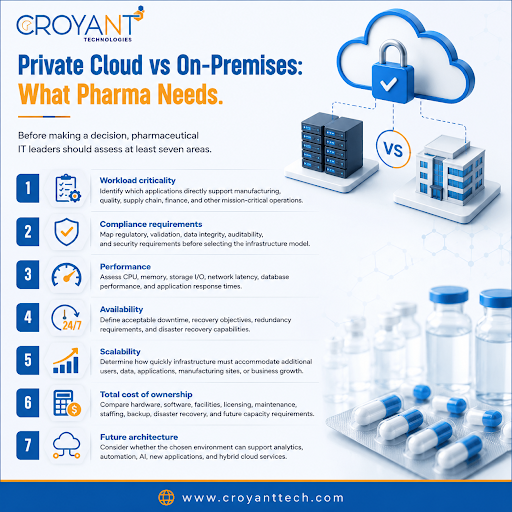
Before making a decision, pharmaceutical IT leaders should assess at least seven areas.
1. Workload criticality
Identify which applications directly support manufacturing, quality, supply chain, finance, and other mission-critical operations.
2. Compliance requirements
Map regulatory, validation, data integrity, auditability, and security requirements before selecting the infrastructure model.
3. Performance
Assess CPU, memory, storage I/O, network latency, database performance, and application response times.
4. Availability
Define acceptable downtime, recovery objectives, redundancy requirements, and disaster recovery capabilities.
5. Scalability
Determine how quickly infrastructure must accommodate additional users, data, applications, manufacturing sites, or business growth.
6. Total cost of ownership
Compare hardware, software, facilities, licensing, maintenance, staffing, backup, disaster recovery, and future capacity requirements.
7. Future architecture
Consider whether the chosen environment can support analytics, automation, AI, new applications, and hybrid cloud services.
This assessment often reveals that the answer is not purely private cloud or purely on-premises.
A hybrid model may be the more practical long-term architecture.
What a Modern Pharmaceutical IT Environment Should Achieve
A successful infrastructure modernization programme should produce measurable business outcomes.
The technology should enable:
Greater operational efficiency: Consolidated infrastructure reduces unnecessary complexity and maintenance overhead.
Improved performance: Modern compute, storage, and database architecture can provide a stronger platform for business-critical applications.
Higher resilience: Clustering, redundancy, monitoring, and disaster recovery reduce infrastructure-related operational risk.
Better scalability: Cloud operating models allow infrastructure capacity to evolve with business requirements.
Stronger compliance readiness: Controls for integrity, availability, security, and auditability become part of the architecture.
Future flexibility: Hybrid cloud provides options for introducing new workloads without forcing every application into the same environment.
These outcomes are visible in the Croyant pharmaceutical engagement. The modernization consolidated the IT environment, reduced maintenance overhead, improved resource utilization, strengthened compliance, and created a foundation for future hybrid cloud and digital initiatives.
So, Which Is Better: Private Cloud or On-Premises Infra for Pharma Manufacturers?
There is no universal winner.
For a pharmaceutical manufacturer with stable workloads, specialized systems, and strong existing infrastructure, on-premises may remain appropriate for some workloads.
For an organization struggling with fragmented infrastructure, increasing maintenance costs, limited scalability, and future cloud ambitions, private cloud can provide a more flexible foundation.
And for many enterprises, the most effective answer is hybrid.
The strategic question should therefore change from:
“Should we choose private cloud or on-premises?”
to:
“Where should each workload operate to deliver the best combination of performance, control, compliance, resilience, and business value?”
That is the question experienced infrastructure architects should help you answer.
Learn about IT modernization vs digital transformation for SMBs
Croyant Technologies: Modernizing Infrastructure With Business Outcomes in Mind
The complexity of pharmaceutical infrastructure modernization requires more than a cloud migration checklist.
Organizations need a partner that understands infrastructure architecture, enterprise applications, databases, high availability, cloud platforms, compliance considerations, and business continuity as interconnected requirements.
Croyant Technologies brings this integrated perspective to IT infrastructure modernization services.
Its pharmaceutical engagement demonstrates experience in private cloud migration, SAP ECC infrastructure, HPE HANA, SUSE Linux, high-availability clustering, and VMware Cloud Foundation-based hybrid cloud architecture.
For organizations evaluating private cloud vs on-premises infrastructure, the objective should not be modernization for its own sake.
The objective is to build an infrastructure foundation that makes the business more resilient, scalable, efficient, and ready for what comes next.
Conclusion
The future of pharmaceutical IT is unlikely to be defined by a single infrastructure model.
It will be defined by workload-aware architecture.
Some workloads may remain on-premises. Others may move to private cloud. New digital workloads may benefit from the public cloud. Hybrid architectures can connect these environments into a coherent operating model.
The winning strategy is therefore not choosing the most fashionable technology.
It is choosing the architecture that best protects today’s operations while creating room for tomorrow’s growth.
That is the real value of infrastructure modernization.
Get in touch with Croyant Technologies experts today to modernize your legacy IT infrastructure.