

For many pharmaceutical manufacturers, SAP ECC is not simply an ERP platform. It sits at the centre of critical business processes, connecting finance, procurement, manufacturing, supply chain, inventory, and other operational functions. That makes one question particularly difficult for IT leaders: How do you modernize the infrastructure supporting SAP ECC without creating new operational risks?
This is where SAP ECC infrastructure modernization becomes more than a technology upgrade. It becomes a business continuity, performance, compliance, and scalability decision.
The pain is familiar. SAP ECC continues to support the business, but the infrastructure underneath it may be fragmented, expensive to maintain, difficult to scale, or increasingly disconnected from newer applications.
Adding another server or fixing another performance issue may solve today’s problem, but it does little to address the underlying architecture.
From my perspective, this is where many modernization programmes go wrong. Organizations focus on replacing technology instead of redesigning the infrastructure around business requirements.
A better approach is to modernize the SAP environment while protecting the operational stability that the business already depends on.
Why SAP ECC Infrastructure Becomes a Modernization Challenge
SAP ECC environments rarely become problematic overnight. They evolve over years.
A business adds line-of-business applications. New servers are introduced. Integrations are built around existing systems. Infrastructure teams create workarounds to accommodate changing requirements. Eventually, what started as a practical solution becomes a highly fragmented environment.
That was the situation highlighted in a Croyant Technologies engagement with a leading pharmaceutical manufacturer. The client’s SAP ECC environment and numerous line-of-business applications were operating across siloed servers, creating data silos, increasing complexity, and driving maintenance costs. The business also faced stringent regulatory requirements and needed an infrastructure foundation capable of supporting a future hybrid cloud strategy.
This illustrates an important point: the problem is rarely SAP ECC itself.
The real problem is whether the infrastructure supporting SAP ECC can continue meeting the organization’s requirements for performance, availability, security, compliance, and growth.
Explore our SAP modernization services and expertise.
What Happens When You Keep Patching the Existing Environment?
The temptation to delay modernization is understandable. If SAP is running, why change it?
Because “running” and “supporting growth” are two very different things.
A fragmented SAP environment can create several hidden costs:
Rising maintenance overhead
IT teams spend more time maintaining servers, troubleshooting integrations, managing dependencies, and responding to infrastructure issues.
Performance constraints
As transaction volumes, users, applications, and data increase, infrastructure that was adequate several years ago can become a bottleneck.
Limited scalability
Adding capacity becomes a complex exercise when workloads depend on tightly coupled infrastructure and legacy configurations.
Higher operational risk
The more fragmented the environment, the more difficult it becomes to identify dependencies and maintain consistent resilience.
Compliance exposure
Pharmaceutical organizations operate in highly regulated environments. Infrastructure must support data integrity, availability, traceability, security, and auditability.
This is why SAP ECC infrastructure modernization should begin with a business and infrastructure assessment rather than a technology shopping list.
A Better Approach to SAP ECC Infrastructure Modernization
The objective should not be to move SAP ECC somewhere else simply because cloud technology is available.
The objective should be to create an infrastructure environment that is more resilient, manageable, scalable, and aligned with the business roadmap.
A practical modernization approach involves five stages.
1. Assess the Existing SAP Ecosystem
Start by understanding what actually exists.
Map:
- SAP ECC workloads
- Databases and storage
- Line-of-business applications
- Integration points
- Network dependencies
- Authentication and access requirements
- Backup and recovery processes
- Performance bottlenecks
- Compliance requirements
Dependency mapping is particularly important. Migrating SAP without understanding the applications and processes connected to it can create operational failures even when the SAP migration itself is technically successful.
2. Define the Target Architecture
Once the existing environment is understood, define where it needs to go.
For some organizations, that could mean a private cloud. For others, hybrid cloud may be more appropriate.
The decision should consider:
- Workload characteristics
- Security requirements
- Compliance obligations
- Performance requirements
- Scalability
- Disaster recovery
- Existing technology investments
- Future digital transformation plans
In the pharmaceutical case, Croyant Technologies migrated SAP ECC to a private cloud built around an HPE HANA Appliance and SUSE Linux, with the objective of improving performance and reliability.
The lesson is important: cloud strategy should follow workload requirements, not the other way around.
3. Build High Availability Into the Architecture
For mission-critical SAP environments, availability cannot be an afterthought.
A resilient architecture should consider:
- Clustered systems
- Redundant infrastructure components
- Automated failover
- Backup and recovery
- Disaster recovery
- Continuous monitoring
- Defined RTO and RPO targets
In the Croyant engagement, HPE Serviceguard Cluster and SUSE Clustering were used to strengthen availability, data integrity, and compliance requirements.
This is a critical distinction between simply migrating infrastructure and modernizing it.
A migration moves workloads.
A modernization programme improves the way those workloads operate.
How Modernization Can Improve SAP Performance
Performance problems are often symptoms of deeper infrastructure constraints.
When SAP response times deteriorate, IT teams may initially look at the application or database. But performance can also be affected by compute capacity, memory, storage, network architecture, workload distribution, and infrastructure configuration.
A properly designed SAP ECC infrastructure modernization programme evaluates these layers together.
For example, modern infrastructure can help organizations:
- Improve resource utilization
- Reduce infrastructure bottlenecks
- Optimize workload placement
- Improve storage performance
- Strengthen database performance
- Simplify infrastructure management
The objective is not simply faster SAP transactions. It is creating a more predictable technology environment for the people and business processes that depend on SAP every day.
Learn more about why Zero Downtime isn’t an option anymore.
Compliance Must Be Designed Into the Infrastructure
For pharmaceutical manufacturers, modernization cannot be separated from compliance.
A faster infrastructure that introduces gaps in data integrity or auditability is not an improvement.
IT leaders must therefore consider compliance during architecture design, migration planning, access management, monitoring, backup, recovery, and validation.
The pharmaceutical case demonstrates this approach. Croyant incorporated compliance-focused measures alongside the infrastructure transformation, with clustering technologies supporting data integrity, availability, and regulatory requirements. The resulting environment reduced compliance risk and strengthened stakeholder trust.
This is the kind of integration between infrastructure and business requirements that separates strategic modernization from routine infrastructure replacement.
Preparing SAP ECC for Hybrid Cloud and Future Growth
Modernization should solve today’s infrastructure challenges without creating tomorrow’s limitations.
That means the target architecture should accommodate future workloads, applications, integrations, analytics, automation, and cloud services.
The Croyant project addressed this requirement by establishing a VMware Cloud Foundation-based hybrid cloud model to create a scalable foundation for future line-of-business applications.
This is particularly valuable for growing organizations because modernization does not need to be a one-time transformation.
A well-designed architecture allows the business to modernize progressively.
SAP workloads can be optimized.
Legacy applications can be integrated.
New workloads can be deployed in more suitable environments.
Cloud services can be introduced where they create value.
That creates an infrastructure roadmap rather than another technology dead end.
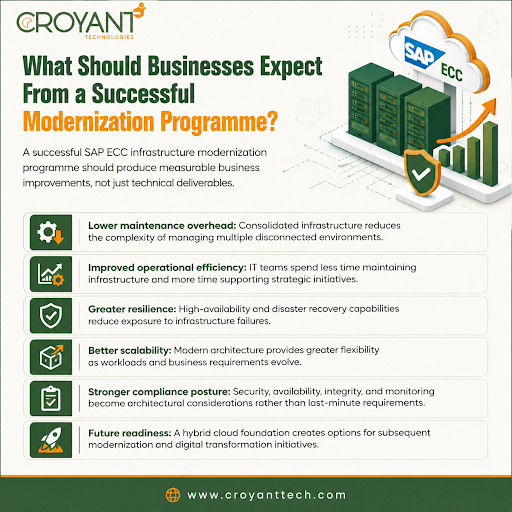
What Should Businesses Expect From a Successful Modernization Programme?
A successful SAP ECC infrastructure modernization programme should produce measurable business improvements, not just technical deliverables.
The most important outcomes include:
Lower maintenance overhead: Consolidated infrastructure reduces the complexity of managing multiple disconnected environments.
Improved operational efficiency: IT teams spend less time maintaining infrastructure and more time supporting strategic initiatives.
Greater resilience: High-availability and disaster recovery capabilities reduce exposure to infrastructure failures.
Better scalability: Modern architecture provides greater flexibility as workloads and business requirements evolve.
Stronger compliance posture: Security, availability, integrity, and monitoring become architectural considerations rather than last-minute requirements.
Future readiness: A hybrid cloud foundation creates options for subsequent modernization and digital transformation initiatives.
The Croyant case study demonstrates these outcomes in practice. The client’s environment was consolidated, maintenance overhead was reduced, resource efficiency improved, and the organization gained a stronger compliance and future scalability foundation.
Croyant Technologies: A Modernization Partner, Not Just a Migration Provider
The difficult part of SAP modernization is not moving workloads.
It is making the right decisions about architecture, dependencies, availability, performance, compliance, and future scalability while keeping the business operational.
That requires experience across infrastructure, cloud, enterprise applications, databases, and business processes.
Croyant Technologies brings that broader perspective to IT infrastructure modernization. Its experience across cloud services, SAP, databases, data engineering, and enterprise solutions enables organizations to approach modernization as an integrated business initiative rather than a collection of disconnected technology projects.
For SMBs and mid-market organizations operating complex SAP environments, the right modernization partner should be able to answer three questions clearly:
What should we modernize?
What should we retain?
How do we modernize without creating unnecessary business risk?
Those answers form the foundation of a modernization roadmap that supports today’s operations while preparing the organization for tomorrow’s growth.
Conclusion: Modernize the Foundation, Not Just the ERP
SAP ECC can continue to deliver business value, but the infrastructure supporting it cannot remain static forever.
When fragmented servers, rising maintenance costs, performance limitations, compliance requirements, and scalability challenges begin constraining the business, modernization becomes a strategic necessity.
The answer is not necessarily to replace everything or move everything to the public cloud.
The smarter approach is to assess the existing environment, design the right target architecture, strengthen availability, modernize critical workloads, integrate legacy applications intelligently, and create a scalable foundation for future growth.
That is what effective SAP ECC infrastructure modernization should achieve: not technology for technology’s sake, but a more resilient, efficient, compliant, and future-ready business.
Contact Croyant Technologies for your Pharma business IT infrastructure modernization services.