


In pharmaceutical manufacturing, a database failure is rarely just an IT problem.
When a database slows down, becomes unavailable, or compromises data integrity, the consequences can move quickly across production, inventory, quality, supply chain, finance, and regulatory processes.
The real question for IT leaders is therefore not simply, “Which database should we use?”
It is:
“Can our database environment keep critical pharmaceutical operations running, protect the integrity of our data, and scale as the business grows?”
That is where Database solutions for Pharma need to be approached differently from conventional database management.
A pharmaceutical manufacturer may have SAP ECC, line-of-business applications, multiple databases, isolated servers, integrations, reporting platforms, and regulatory controls operating together. Over time, this creates complexity. The database environment becomes harder to monitor, maintain, secure, scale, and recover.
A recent Croyant Technologies engagement with a leading pharmaceutical manufacturer illustrates this challenge particularly well. The organization was operating SAP ECC alongside multiple LOB applications on isolated servers, creating data silos, increasing complexity, and driving maintenance costs.
At the same time, stringent regulatory requirements demanded stronger controls around data integrity, availability, and compliance.
The lesson is important: modern pharmaceutical database architecture must be designed around business continuity and data integrity, not simply database performance.
Why Pharmaceutical Database Environments Become Complex
Most database problems are not caused by a single poorly configured database.
They emerge from years of incremental technology decisions.
An organization adds an application here, a reporting system there, another server for a new business unit, and an integration layer to connect two systems. Eventually, data becomes distributed across multiple environments.
That creates several challenges:
- Data silos across applications
- Duplicate or inconsistent information
- Increasing infrastructure maintenance
- Difficult backup and recovery processes
- Performance bottlenecks
- Limited visibility into database dependencies
- Higher security and compliance exposure
- Difficulty scaling for new workloads
For pharmaceutical manufacturers, these problems are particularly serious because data supports processes where accuracy, traceability, availability, and integrity matter enormously.
This is why Database management solutions for Pharma should begin with an assessment of the entire data ecosystem rather than focusing on an individual database instance.
The Real Business Risk of Fragmented Databases
It is tempting to look at database fragmentation as a technical inconvenience.
It is much more than that.
When critical data sits across disconnected systems, teams may struggle to establish a consistent view of operations. IT teams spend more time maintaining infrastructure. Business teams wait longer for reports. Application integrations become fragile.
And when a critical database becomes unavailable, downstream processes can stop with it.
The result can include:
Operational disruption: Manufacturing and business applications may depend on database availability.
Decision-making delays: Inconsistent or inaccessible data makes timely decisions harder.
Compliance exposure: Inadequate controls can compromise auditability and data integrity.
Higher IT costs: More environments mean more infrastructure, licensing, monitoring, maintenance, and specialist skills.
Limited scalability: Adding applications and workloads becomes increasingly difficult when the underlying architecture is fragmented.
From a business perspective, the database is therefore part of the operational foundation, not merely a backend technology.
What Should Modern Database Infrastructure for Pharma Deliver?
A modern database environment should deliver five fundamental capabilities.
1. Availability
Critical pharmaceutical applications should not depend on a single point of failure.
High-availability architecture can use clustering, redundancy, automated failover, and resilient infrastructure to reduce the impact of hardware, software, or infrastructure failures.
2. Data Integrity
Pharmaceutical organizations need confidence that the data being stored, processed, transferred, and reported remains accurate and consistent.
Database architecture must therefore support appropriate controls for access, change management, backup, recovery, monitoring, and auditability.
3. Performance
Database performance directly influences application performance.
A poorly optimized database can create slow ERP transactions, delayed reports, application timeouts, and frustrated users.
Modern infrastructure should therefore consider:
- Compute capacity
- Memory
- Storage I/O
- Network latency
- Database configuration
- Workload patterns
- Query performance
4. Scalability
A database architecture that performs well today may struggle when transaction volumes, users, data, or applications increase.
The architecture must accommodate growth without requiring disruptive infrastructure redesign every time the business expands.
5. Recoverability
Availability and recovery are not the same thing.
High availability helps keep systems running when components fail. Disaster recovery provides a strategy for restoring operations after a larger disruption.
Pharmaceutical IT leaders should define appropriate Recovery Time Objectives (RTOs) and Recovery Point Objectives (RPOs) for critical workloads and design the database environment accordingly.
Learn the top 10 reasons why your business need a database expert services.
How Croyant Approached the Pharmaceutical Infrastructure Challenge
The Croyant Technologies case study provides a useful example of what this approach looks like in practice.
The client faced fragmented IT systems, with SAP ECC and multiple LOB applications operating across isolated servers. This architecture created data silos, increased complexity, and raised maintenance costs. The organization also needed to meet stringent regulatory requirements while preparing for future growth and digital transformation.
Croyant did not treat the problem as simply a database tuning exercise.
Instead, it addressed the broader infrastructure supporting the client’s critical applications.
The SAP ECC environment was transitioned to a private cloud using an HPE HANA Appliance and SUSE Linux, improving the performance and reliability foundation.
For high availability and compliance requirements, Croyant implemented HPE Serviceguard Cluster and SUSE Clustering technologies to strengthen data integrity, availability, and resilience.
The organization also established a VMware Cloud Foundation-based hybrid cloud model, creating a foundation for scalable line-of-business applications and future digital initiatives.
This is a crucial distinction.
Croyant did not simply modernize individual technology components.
It created a more integrated infrastructure foundation around the business’s critical workloads.
Learn more about how to modernize SAP ECC infrastructure.
Why High Availability Matters for Pharmaceutical Databases
Imagine an ERP database supporting procurement, inventory, finance, and manufacturing-related processes suddenly becoming unavailable.
The database team may see an infrastructure incident.
Operations may see halted workflows.
Finance may see delayed transactions.
Management may see business disruption.
The same technical failure can therefore create multiple business consequences.
High-availability architecture helps reduce this exposure by introducing redundancy and failover mechanisms.
In the Croyant engagement, clustering technologies were used as part of the infrastructure strategy to support high availability and disaster recovery while addressing data integrity and regulatory requirements.
This demonstrates a broader principle:
Database resilience should be designed according to business criticality.
Not every database needs the same architecture. A mission-critical manufacturing or ERP workload deserves a very different availability strategy from a departmental reporting database.
Database Modernization Does Not Mean Replacing Everything
This is another area where organizations often make an expensive mistake.
Modernization does not necessarily mean abandoning existing databases or applications.
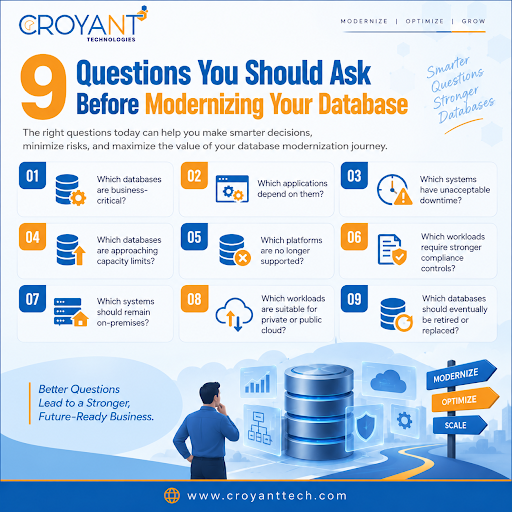
A better approach starts by classifying workloads.
Ask:
- Which databases are business-critical?
- Which applications depend on them?
- Which systems have unacceptable downtime?
- Which databases are approaching capacity limits?
- Which platforms are no longer supported?
- Which workloads require stronger compliance controls?
- Which systems should remain on-premises?
- Which workloads are suitable for private or public cloud?
- Which databases should eventually be retired or replaced?
This creates a practical modernization roadmap.
Some workloads may require migration.
Others may need optimization.
Some may benefit from consolidation.
Others may simply require better monitoring, backup, security, and resilience.
The objective is to modernize intelligently, not indiscriminately.
From Database Modernization to a Future-Ready Data Architecture
The long-term opportunity goes beyond fixing today’s database problems.
Pharmaceutical companies increasingly need infrastructure capable of supporting analytics, automation, AI, connected manufacturing, digital supply chains, and real-time decision-making.
These initiatives depend on reliable data.
If critical information remains locked inside fragmented legacy environments, digital transformation becomes harder and more expensive.
That is why database modernization should be viewed as an enabling layer for future innovation.
The Croyant engagement demonstrates this principle through its hybrid-cloud foundation, designed to support scalable LOB applications and future digital initiatives.
A modern database strategy should therefore answer two questions simultaneously:
How do we make today’s critical systems more resilient?
How do we create a data foundation that supports tomorrow’s technology?
Organizations that answer both questions are far better positioned for sustainable transformation.
Read more about the top database performance tuning challenges and their solutions.
Choosing the Right Database Modernization Partner
Pharmaceutical database modernization requires more than database administration expertise.
The partner needs to understand the relationship between databases, applications, infrastructure, cloud architecture, high availability, security, compliance, and business continuity.
That integrated perspective is one of Croyant Technologies’ strengths.
Croyant provides database management expertise across technologies including Oracle, Microsoft SQL Server, MySQL, PostgreSQL, and MongoDB, alongside enterprise, cloud, and data-engineering capabilities.
Its pharmaceutical infrastructure engagement demonstrates how these capabilities can come together within a broader modernization programme.
For organizations evaluating Database solutions for Pharma, the objective should not be simply to deploy a newer database.
It should be to build a reliable, resilient, secure, scalable, and future-ready data foundation.
Conclusion: Your Database Is Part of Your Manufacturing Infrastructure
Pharmaceutical manufacturers cannot afford to treat databases as isolated IT components.
They support the applications and processes that keep the business operating.
When database environments become fragmented, performance deteriorates, maintenance costs increase, and resilience becomes harder to guarantee. More importantly, these problems can eventually affect business continuity and compliance.
The right modernization strategy brings databases, applications, infrastructure, cloud architecture, high availability, and business requirements together.
That is the real purpose of Database solutions for Pharma.
Croyant Technologies helps organizations take that broader approach. With experience across database technologies, SAP, cloud infrastructure, high availability, and enterprise modernization, Croyant can help pharmaceutical and other regulated businesses move from fragmented database environments toward resilient, scalable infrastructure.
The goal is not simply to modernize your database. It is to make your data infrastructure strong enough to support the business you want to build next.
Contact us for modern database management and migration solutions.