

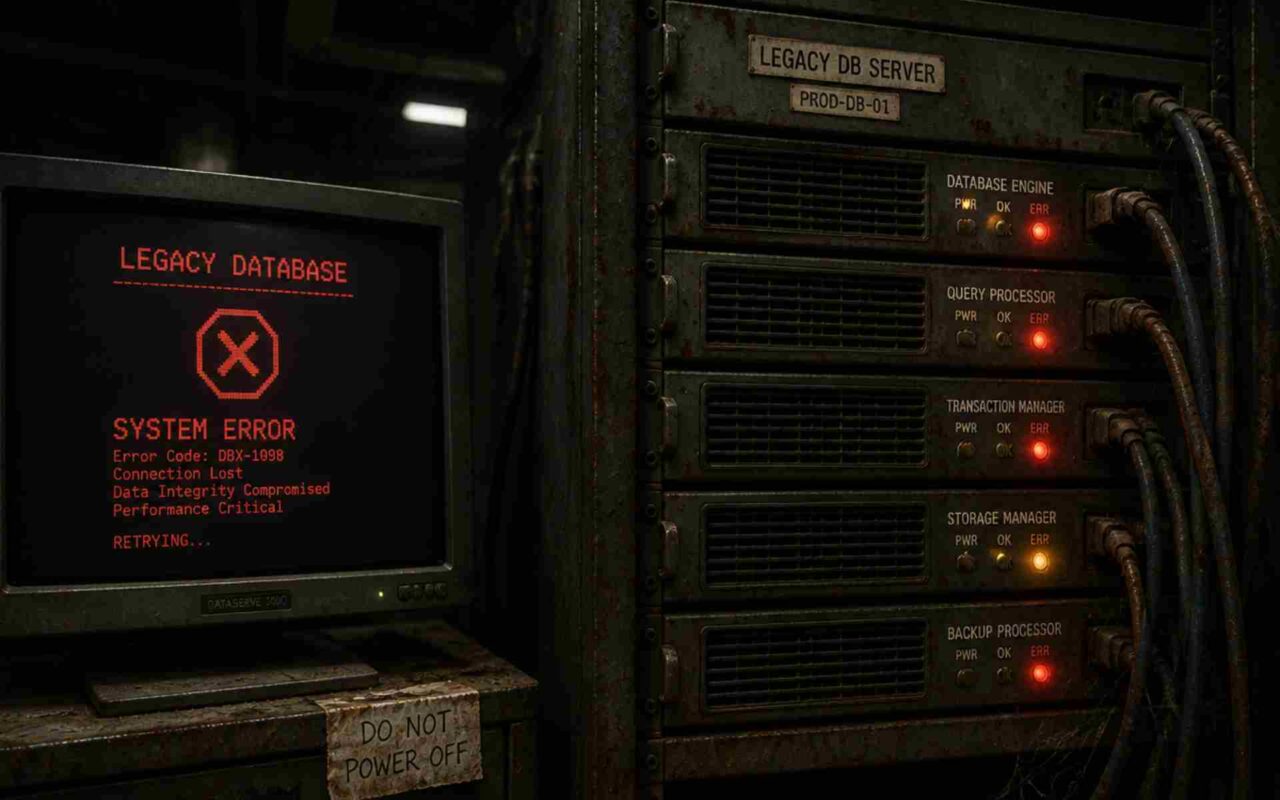
Is your legacy database an engine for growth or an anchor dragging you down?
In the high-velocity world of modern data architecture, relying on a legacy database is often the silent killer of agility. As a senior database management expert, I’ve seen firsthand how aging infrastructure doesn’t just “get slower”—it actively corrodes competitive advantage. It starts with minor delays and evolves into critical security gaps and exorbitant costs.
If you suspect your infrastructure is past its prime, here are 7 undeniable signs your legacy database is hurting your business performance, along with a real-world look at how transformation is possible.
1. Performance Bottlenecks and Latency
The most visceral sign is speed, or the lack of it. Modern applications demand millisecond response times. If your team is complaining about “spinning wheels” or reports that take hours to generate, your legacy database is likely struggling with I/O throughput.
- The Symptom: Queries that used to run instantly now hang, causing application timeouts.
- The Impact: Customer dissatisfaction and lost revenue. 53% of mobile users abandon sites that take longer than 3 seconds to load. Your database’s inability to serve data quickly directly impacts the frontend experience.
2. Escalating Maintenance Costs
A clear financial red flag is when the cost to keep the lights on outpaces the cost of innovation. Maintaining a legacy database often requires niche expertise—DBAs who know decades-old proprietary code or specific versions of COBOL, Oracle, or DB2 that are no longer standard.
- The Symptom: Your IT budget is consumed by “keeping the system running” rather than new features.
- The Reality: You are paying a premium for scarcity. As vendors retire support for older versions, you face extended support fees or expensive third-party contracts just to receive critical patches.
3. Security Vulnerabilities and Compliance Risks
Newer databases are built with “security by design,” featuring encryption at rest and in transit. A legacy database, conversely, often relies on perimeter security that is no longer sufficient against modern threats like ransomware or SQL injection.
- The Risk: Unpatched vulnerabilities are open doors for attackers.
- The Consequence: Non-compliance with GDPR, HIPAA, or CCPA. If your database cannot natively support modern encryption standards or audit trails, you are one audit away from massive fines.
4. Integration Nightmares (The “Data Silo” Effect)
Modern business thrives on connectivity—CRMs talking to ERPs, feeding into AI analytics. A legacy database is often a walled garden. It lacks the APIs or native connectors to integrate with modern SaaS tools like Salesforce, Snowflake, or Tableau.
- The Symptom: Your team relies on manual CSV exports and imports to move data between systems.
- The Impact: Data silos. You cannot get a “360-degree view” of your customer because the data is trapped in an incompatible, monolithic format.
Know the impact of legacy systems on performance
5. Inability to Scale (Rigid Architecture)
Scalability is the ability to handle growth without a complete overhaul. Modern databases (especially NoSQL or NewSQL) scale horizontally—you just add more commodity servers. A legacy database typically scales vertically; to get more power, you must buy a bigger, more expensive mainframe or server.
- The Ceiling: You hit a hard limit on transactions per second (TPS).
- The Result: During peak traffic (like Black Friday), the system crashes because the hardware simply cannot handle the load, and you cannot provision more capacity instantly.
6. Data Inconsistency and Poor Quality
Over decades, legacy database schemas become cluttered with “band-aid” fixes, duplicated tables, and inconsistent data types. Without modern validation rules, “dirty data” proliferates.
- The Symptom: Reports from two different departments show different revenue figures for the same period.
- The Impact: mistrust in data. Executives stop relying on dashboards because they don’t trust the underlying numbers, leading to gut-feel decision-making rather than data-driven strategy.
7. Vendor Lock-In and Lack of Support
Perhaps the most strategic risk is being held hostage by a single vendor. Many legacy database contracts were written years ago, with punitive licensing models that punish you for modernizing or moving to the cloud.
- The Trap: You cannot move to an open-source alternative (like PostgreSQL) because your business logic is buried in proprietary stored procedures.
- The Reality: You are paying for “shelfware”—features you don’t use but are forced to license.
The hidden costs of poor IT infrastructure on your business growth and scalability.
Real-World Example: A Tale of IT Transformation
To illustrate the path forward, let’s look at a case study titled “Navigating Challenges, Achieving Growth: A Tale of IT Transformation” by Croyant Tech.
This case study exemplifies the journey of a business crippled by the exact signs listed above—specifically bottlenecks and integration rigidity. The organization faced a critical “adapt or die” moment where their legacy database infrastructure could no longer support their growth ambitions.
The Transformation Approach:
- Assess: Croyant Tech began by identifying specific pain points. They didn’t just look at the code; they looked at the business impact—where were the bottlenecks hindering efficiency? They found that the legacy database was the root cause of slow reporting and customer friction.
- Analyze: They moved beyond symptoms to analyze the infrastructure. The analysis revealed that the underlying architecture was rigid, preventing the integration of modern analytics tools required for strategic decision-making.
- Design: Instead of a “band-aid” patch, they designed a customized IT strategy. This involved a calculated migration plan that prioritized data integrity and minimized downtime.
The Outcome:
By modernizing their legacy database environment, the client shifted from a reactive “fix-it” stance to a proactive growth model. They unlocked real-time data access, reduced maintenance overhead, and regained the ability to scale their operations confidently. [Case study]
This case proves that while the transition away from a legacy database is complex, the ROI is measured not just in saved IT costs, but in unlocked business potential.
Conclusion
Clinging to a legacy database is a choice to prioritize the comfort of the status quo over the necessity of future growth. If you recognize even three of the seven signs above, your database is already acting as a brake on your business performance.
The path to modernization—as shown in the Croyant Technologies case study—begins with an honest assessment and ends with a liberated, agile enterprise.
Don’t let your history dictate your future. Start planning your migration today.